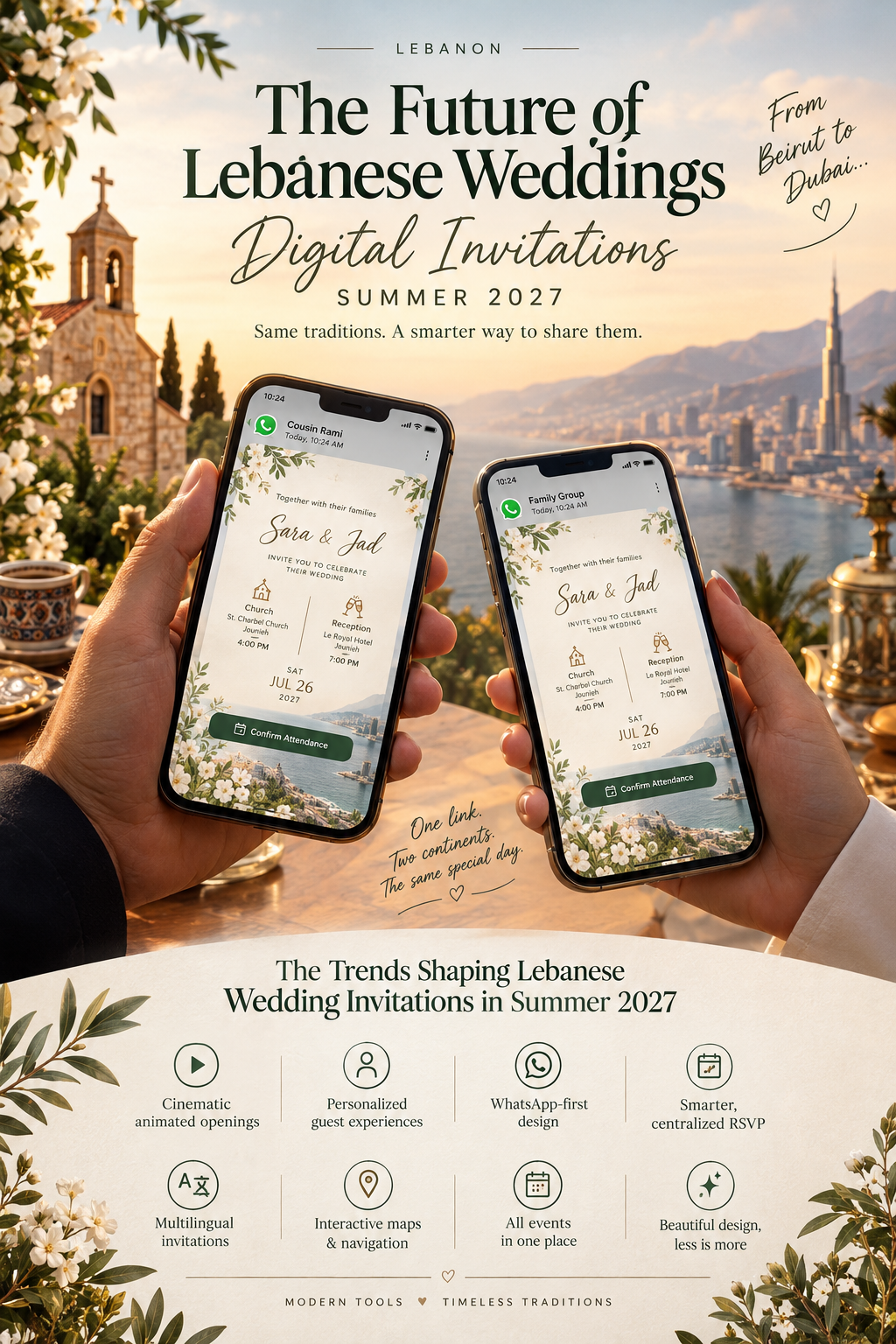
A guest in Beirut opens a WhatsApp message from a cousin getting married in Jounieh. A guest in Dubai opens the same message a few seconds later. Both tap the same link, and both see the same invitation: the couple's names, the church, the reception, a map, and a button to confirm they're coming. Neither of them had to wait for a card to arrive in the post, and neither of them had to call anyone to ask what time the Zaffeh starts.
That small moment, two people on two continents opening the same invitation at the same time, is a quiet summary of where Lebanese wedding invitations are heading. Summer 2027 looks set to be the point where digital invitations stop being a simple replacement for a printed card and start becoming something closer to a small, self-contained wedding experience: a place guests go to understand the day, not just to be told it's happening.
Lebanese Weddings Are Changing, But Not Their Traditions
None of this is about replacing what makes a Lebanese wedding feel like a Lebanese wedding. The church ceremony, the Katb Ktab, the Zaffeh winding through a village square or hotel lobby, the engagement party that sometimes feels like a wedding in its own right, these stay exactly as they are. Lebanese weddings are still occasions that bring entire families together, often with guest lists running into the hundreds, and that isn't changing because an invitation is now a link instead of a card.
What's changing is the layer underneath the tradition: how everyone is told, how questions get answered, and how a couple keeps a few hundred relatives informed without everything running through one exhausted WhatsApp thread.
What Is Driving the Shift Toward Digital Invitations?
A few practical realities are pushing more couples toward digital invitations, and none of them are really about technology for its own sake.
Lebanese guest lists are rarely local. Between relatives in the Gulf, cousins in Europe, and friends who left for North America or Australia years ago, a single wedding can span several time zones. Printed invitations have to be designed, printed, and physically delivered to every one of those places, which takes time and money and leaves little room for error if a detail changes.
At the same time, the way Lebanese families already communicate has shifted decisively toward WhatsApp. A 2019 Pew Research Center survey found that 84% of Lebanese adults used WhatsApp, among the highest rates recorded anywhere in the survey, with usage close to universal among people under 30. Wedding invitations were always going to end up traveling through that channel eventually, whether couples planned for it or not; the only question was whether they'd arrive as a blurry photo of a printed card or as something built to be opened on a phone.
The Digital Wedding Invitation Trends to Watch for Summer 2027
Some of what follows is already well established. Some of it is clearly growing but not yet universal. A few ideas are genuinely emerging and worth watching rather than treating as settled, and we've tried to be honest about which is which.
1. Cinematic, animated openings
Rather than a static page, invitations increasingly open with a short animated sequence, an envelope unfolding, a title card fading in, a subtle motion through the couple's names and date, before settling into the main experience. Done well, this is restrained rather than flashy: a few seconds that set a tone, not a show.
2. Personalized guest experiences
A guest's name appearing in their own invitation, or a family seeing a slightly different message than a colleague would, is becoming more common. For a Lebanese guest list that might include immediate family, extended family, and friends from several different circles, this kind of personalization is less a gimmick and more a way of making a five-hundred-guest wedding still feel considered at an individual level.
3. WhatsApp-first design
This one is already fully established in Lebanon, not emerging. Invitations are increasingly designed with the assumption that the first (and often only) place a guest will open them is inside WhatsApp, forwarded from a family group chat. That means the link itself, the preview image, and the loading experience all matter as much as the invitation's interior design.
4. Smarter, centralized RSVP
Online RSVP, with responses collected automatically in one place instead of scattered across calls, voice notes, and messages to the bride's mother, is now a standard expectation rather than a novelty. For Lebanese weddings specifically, where group and family RSVPs are common, this is one of the most immediately useful pieces of the whole shift.
5. Multilingual invitations
Arabic and English together, and increasingly French where a family's guest list calls for it, let one invitation serve grandparents, guests abroad, and everyone in between without anyone needing a translation.
6. Interactive maps and navigation
An embedded map for the church and a separate one for the reception, rather than an address typed out and hoped for, matters more in Lebanon than almost anywhere: venues down unmarked roads, churches tucked into mountain villages, and entrances that aren't always where they look like they should be.
7. Organizing multiple events in one place
Engagement, Katb Ktab, church ceremony, reception, Zaffeh, and sometimes an after-party: a Lebanese wedding is rarely a single event, and a digital invitation can hold the timing and details for all of them in one place instead of scattered across separate messages and cards.
8. Restraint over spectacle in animation
The clearest shift in design sensibility is away from invitations trying to impress through sheer amount of movement, and toward a small number of intentional, well-placed animated touches. The trend line is toward less, used more deliberately.
9. Music and atmosphere, used carefully
Background music that starts softly when an invitation opens, with an obvious way to turn it off, is common and well liked when it's optional and unobtrusive. Audio that autoplays loudly and can't easily be silenced is the version guests remember for the wrong reasons.
10. Video, used sparingly
Short couple videos or a brief venue clip are appearing more often, though the more consistent trend is couples and designers being careful about file size and loading time, since a beautiful video that takes fifteen seconds to load on a mobile connection works against the experience it's meant to create.
11. QR codes extending into the real world
This is one of the more clearly documented shifts: The Knot's 2026 Newlywed Study found that 59% of couples used QR codes somewhere in their wedding that year, up from just 7% in 2021, and Zola reported a 42.5% rise in QR codes on save-the-dates and invitations between 2024 and 2026. In practice, that means a code on a save-the-date or at the venue that links back to the same digital invitation guests already have, for directions, RSVP, or photo sharing.
12. Guest photo and memory sharing
Letting guests contribute photos or short messages after the wedding, extending the invitation into something that lives on a little past the day itself, is a growing idea, though it's still more emerging than standard, and worth treating as optional rather than expected.
13. AI as an assistant, not a replacement
According to The Knot Worldwide's 2025 trends research, the share of couples using AI somewhere in wedding planning doubled year over year, from roughly one in ten to one in five, mostly for things like wording suggestions, etiquette questions, and inspiration. For invitations specifically, that's likely to mean quieter uses, like help translating a message accurately or suggesting wording, rather than anything that changes what the couple is actually saying. This is a genuinely emerging trend for 2027 rather than an established one, and it's worth being skeptical of anyone claiming otherwise.
14. Less paper, fewer reprints
Sustainability searches around weddings have grown sharply, eco-friendly invitation searches were up nearly 400% year over year by early 2026 according to Greenhive's tracking, and a digital invitation is one of the more straightforward ways to act on that without changing anything else about the wedding. It also solves a very practical problem: when a detail changes, the same link gets updated instead of a new batch of cards getting printed.
15. Digital as a luxury category of its own
Perhaps the most important shift for 2027 is that digital is no longer treated as the budget option. Editorial typography, considered color palettes, custom illustration, and design inspired by Lebanese or Mediterranean landscapes are showing up in digital invitations the same way they always have in print. The format isn't what determines whether something feels luxurious; the design decisions are.
What Will the Best Lebanese Digital Wedding Invitations Look Like in Summer 2027?
Picture it: a guest gets a WhatsApp message with a single link. They tap it, a brief loading animation plays, and the invitation opens with the couple's names appearing over a quiet, elegant transition. There's a small, clearly visible button to turn music on if they'd like it.
From there, they move through a short story of the couple, the wedding date and a countdown, the church ceremony details, the Katb Ktab if the family is holding one separately, the reception information, and where the Zaffeh will begin. A map button takes them straight to the church; a separate one takes them to the venue. They confirm their RSVP in a few taps, see the dress code if there is one, and find a contact number for questions. If they're more comfortable reading in Arabic, English, or French, the invitation shows it to them in that language without anyone needing to send a separate version.
None of this needs to feel like using an app. Done well, it feels like reading a beautifully designed page that happens to also answer every practical question before anyone has to ask it.
10 Things You Can Add to Make Your Wedding Experience Better
- A personalized greeting. Seeing their own name, or their family's name, makes even a large guest list feel considered.
- A countdown to the date. A small, elegant touch that builds anticipation without adding complexity.
- An interactive map. Especially valuable when the ceremony and reception are in different places, which is common in Lebanon.
- Centralized RSVP tracking. Removes the single biggest source of last-minute stress for Lebanese guest lists.
- A WhatsApp-ready link. Since that's realistically how most guests will receive it regardless of what else is planned.
- Multilingual support. Arabic and English as a baseline, French where the guest list calls for it.
- A short wedding story. A few lines or images about the couple, for guests who may not know the full story.
- Optional background music. Sets the mood, as long as guests can turn it off easily.
- A few well-chosen photos. More effective than a long gallery, which slows the page down on mobile.
- Clear contact information. One place guests can go with a question instead of guessing who to call.
WhatsApp Will Continue to Be Central to Lebanese Wedding Communication
It's worth stating plainly: in Lebanon, WhatsApp isn't one channel among several for wedding communication, it's effectively the main one. Given how dominant it already is for everyday family communication, there's little reason to expect that to change by 2027. The practical implication for invitations is that the design and technical choices (how fast the link loads, how it previews when shared, how it behaves on an older phone with a weaker connection) matter just as much as how the invitation looks once it's open.
Why Mobile-First Design Matters
If a guest is going to open an invitation from a WhatsApp message, they're opening it on a phone, almost without exception. That means fast loading over an average mobile connection, buttons sized for a thumb rather than a cursor, text that's readable without zooming, and images and video compressed enough that they don't stall on a slower connection. An invitation that was clearly designed for a desktop screen first, with everything else as an afterthought, is one of the more common and avoidable mistakes.
Digital Invitations Are Becoming More Personal
There's a reasonable instinct that something sent as a link feels less personal than something handed over by hand. In practice, a well-built digital invitation can go the other way: generated for a specific guest or family, with their name part of the experience rather than a line on a mailing list, it can feel more considered than a card produced identically five hundred times over.
The Rise of Interactive Wedding Experiences
The common thread through most of the trends above is that the invitation is no longer a one-way announcement. It's closer to a small interactive space: guests can confirm attendance, get directions, choose a language, and find what they need without a single phone call. That shift, from telling guests something to giving them somewhere to go, is probably the most meaningful change in how Lebanese couples are thinking about invitations for 2027.
What Not to Do With a Digital Wedding Invitation
Luxury, in this particular format, is often about restraint. A few things worth avoiding:
- Too many animations stacked on top of each other, which tends to feel busy rather than elegant
- Large, uncompressed videos that make the page slow to load
- Background audio that autoplays loudly with no obvious way to turn it off
- Navigation that isn't obvious, forcing guests to hunt for the RSVP button or the map
- Text too small to read comfortably on a phone
- RSVP forms with more fields than actually necessary
- A design built for desktop first, with mobile treated as an afterthought
- Sections added because they're possible, not because they're useful
- Heavy reliance on AI-generated text or visuals that end up feeling generic
- A layout that could belong to any couple, rather than this one
Digital Doesn't Mean Less Elegant
This remains the biggest hesitation for a lot of couples, and it's worth addressing directly: the format isn't what determines elegance. A printed card and a digital invitation can both be beautifully designed, and both can be poorly designed. What digital adds is simply more room, for music, for a map, for RSVP tracking, for a language switch, none of which has to come at the cost of how refined the invitation feels.
A More Practical Wedding Without Losing the Tradition
Put together, none of this changes what a Lebanese wedding actually is. It changes how guests find out about it, how questions get answered, and how a couple keeps a few hundred relatives on the same page without it becoming a second job in the months before the wedding. For a lot of couples, that turns out to be a meaningful amount of stress removed from a season that already has enough going on.
What Should a Lebanese Digital Wedding Invitation Include?
At minimum, a strong Lebanese digital invitation should cover:
- Couple's names and wedding date
- Ceremony details: church and/or Katb Ktab, with timing
- Reception details and timing
- Venue locations with a clear map
- A way to RSVP
- Guest-specific information where relevant
- Dress code, if there is one
- Contact information for questions
- A touch of music or visual identity that reflects the couple
- Arabic and English, with French where it suits the guest list
Final Thoughts
Summer 2027 isn't likely to bring a single dramatic change to how Lebanese couples send wedding invitations. It's more a continuation of something already underway: invitations slowly becoming less about replacing a piece of paper and more about giving guests, wherever they happen to be, one clear, well-designed place to understand the day and confirm they'll be there.
About Pulss Wave Technology
Pulss Wave Technology is a Lebanon-based studio, located in Rabieh, Metn, that designs interactive digital wedding invitations for couples across the country. Each invitation is custom-designed around the couple rather than built from a fixed template, and includes an embedded venue map, background music, and the option of Arabic translation alongside the standard English design. Higher-tier packages add RSVP tracking and a personalized link generated for each individual guest, with guest notes and a QR code feature available as extras. You can see the full breakdown on our digital wedding invitations page, and read our earlier piece on how going digital also means less paper waste.
If you're planning a wedding in Lebanon for Summer 2027 and want an invitation that feels both elegant and genuinely useful to your guests, Pulss Wave Technology can help you build one designed around your celebration.
Sources & Trend Research
- The Knot 2026 Newlywed Study, via The Star — QR code adoption among couples, 2021 vs. 2026
- Pew Research Center, "Protests in Lebanon highlight ubiquity of WhatsApp" — WhatsApp adoption among Lebanese adults
- Greenhive, "Eco-Friendly Wedding Invitation Searches Are Up Nearly 400%" — sustainable invitation search trends
- The Knot Worldwide 2025 Trends research, via Nashville Bride Guide — AI adoption in wedding planning
- Wedded Wonderland, "7 big and electrifying Lebanese wedding traditions" — Zaffeh and Lebanese wedding customs
- The Knot, "Lebanese Wedding Traditions" — Katb Ktab and ceremony customs
Statistics above come from US/global wedding-industry studies (The Knot, Zola, Greenhive) rather than Lebanon-specific research, since no equivalent Lebanon-specific datasets were found; they're included as directional industry context, not as claims about Lebanese couples specifically. The WhatsApp adoption figure is Lebanon-specific but from a 2019 survey, the most recent authoritative figure available.